WELCOME TO THE SHIVI FITNESS
Welcome to The Shivi Fitness, where strength meets dedication and transformation begins!
At Shivi Fitness, we believe that fitness is not just about building muscles — it’s about building confidence, discipline, and a healthier lifestyle. Our mission is to help every individual unlock their true potential through expert guidance, structured training programs, and a motivating environment.
Shoulder Injury Prevention & Joint Stability
Objective: To provide clients with clear, practical education on how to prevent shoulder injuries while
improving joint stability and long-term performance

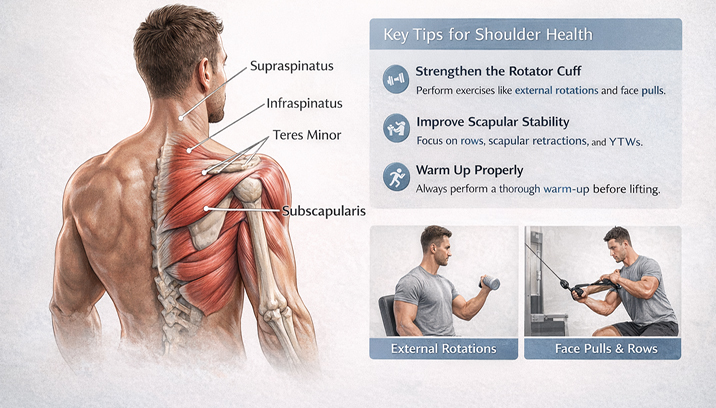
The shoulder is a ball-and-socket joint that allows movement in multiple directions. Because of this
large range of motion, it depends heavily on muscular control for stability. Stability means the joint
remains centered and controlled during movement. The rotator cuff is a group of four small muscles
that help keep the upper arm bone aligned within the shoulder joint. The scapula, also known as the
shoulder blade, provides a stable base for arm movement. Common causes of shoulder discomfort
include poor posture, excessive pressing exercises without balancing pulling movements, weak rotator
cuff endurance, and sudden increases in training volume. Strategies to Reduce Injury Risk: 1. Balance
push and pull exercises. 2. Strengthen the rotator cuff using light resistance and controlled tempo. 3.
Maintain neutral posture during workouts and daily activities. 4. Perform a dynamic warm-up before
upper body training. 5. Stop activity if sharp or joint-specific pain occurs and consult a healthcare
professional if needed
Rest & Recovery for Strength & Muscle Development
Objective: To educate clients on why proper recovery is essential for muscle growth, performance
improvement, and injury prevention.
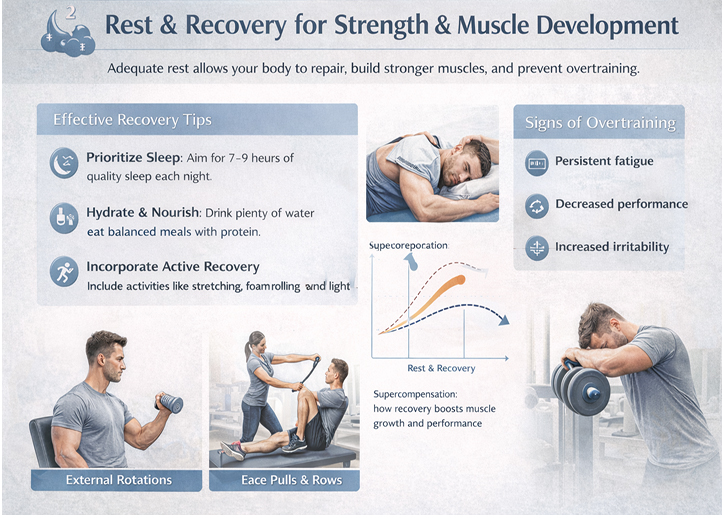
Resistance training creates small amounts of stress within muscle tissue. The body adapts and
becomes stronger during recovery, not during the workout itself. Recovery includes sleep, rest days,
hydration, and managing overall training load. Without adequate recovery, performance decreases and
the risk of injury increases. Key Recovery Guidelines: 1. Aim for 7–9 hours of quality sleep per night. 2.
Allow at least 48 hours before training the same muscle group intensely again. 3. Include light activity
such as walking or mobility work on rest days. 4. Maintain proper hydration to support circulation and
tissue repair. 5. Monitor signs of excessive fatigue, irritability, or declining performance. Consistent
recovery habits are essential for safe, sustainable progress in strength and muscle development
References
American College of Sports Medicine. (2021). ACSM’s Guidelines for Exercise Testing and Prescription
(11th ed.). Schoenfeld, B. J. (2010). The mechanisms of muscle hypertrophy and their application to
resistance training. Journal of Strength and Conditioning Research, 24(10), 2857–2872. Wilk, K. E.,
Reinold, M. M., & Andrews, J. R. (2020). Current concepts in the rehabilitation of the athletic shoulder.
International Journal of Sports Physical Therapy, 15(3), 601–616. Kreher, J. B., & Schwartz, J. B.
(2012). Overtraining syndrome: A practical guide. Sports Health, 4(2), 128–138